
Medical & Weight Management Disclaimer
This article is provided for general educational and informational
purposes only. Weight, nutrition, exercise needs, menopause experiences,
medications, and medical conditions vary from person to person. The
information provided here should not be used to diagnose, treat, or
prevent a medical condition. Speak with a qualified healthcare
professional or registered dietitian before making significant changes
to your diet, exercise routine, or weight-management plan.
Sustainable weight loss after 40 is rarely about following the newest diet
or dramatically cutting calories. During midlife, changes in body
composition, activity levels, sleep, appetite, and the menopausal transition
can make weight management feel different than it did earlier in life.
That does not mean calories stop mattering. Long-term changes in body weight
are still influenced by energy intake and energy expenditure. However,
focusing only on calorie numbers can overlook nutrition quality, muscle
preservation, physical activity, sleep, appetite, and how realistic a plan
is for everyday life.
A more sustainable approach combines balanced nutrition, regular physical
activity, muscle-strengthening exercise, adequate recovery, and habits that
can realistically be maintained over time.
This guide explains an evidence-informed framework for women over 40 who
want to approach weight management without relying on fad diets or extreme
restrictions.
The Sustainable Weight-Loss Framework
- Build meals around nutrient-dense foods.
- Include adequate protein and fiber.
- Preserve muscle with resistance training.
- Include regular aerobic and everyday movement.
- Prioritize consistent sleep and recovery.
- Avoid extreme diets that are difficult to maintain.
-
Seek individualized professional guidance when medical conditions or
medications may affect weight management.

Why Weight Management Can Feel Different After 40
The years around menopause can involve changes in hormone levels, body-fat
distribution, muscle mass, sleep, and other aspects of health. These changes
are not identical for every woman. Aging, physical activity, eating habits,
and changes in muscle mass can also influence energy needs and body weight.
The U.S. Office on Women’s Health explains that weight changes after
menopause may be influenced by lower estrogen levels, aging, reduced
activity, eating patterns, and loss of muscle mass.
The goal, therefore, should not be to search for one “hormone-balancing”
solution. A more useful strategy is to build several sustainable habits
that support nutrition, movement, muscle, sleep, and overall health.
Office on Women’s Health — Menopause and Your Health
1. Start With a Sustainable Energy Balance
Calories still matter in weight management. The body requires energy for
basic functions and daily activity, and long-term changes in body weight are
influenced by the relationship between energy intake and energy expenditure.
At the same time, a sustainable eating pattern is about more than calorie
counting. Food quality, hunger, fullness, muscle preservation, activity,
sleep, and personal preferences can all influence whether a plan is
realistic enough to maintain.
Instead of adopting an extreme calorie deficit, consider a moderate,
sustainable approach built around nutrient-dense foods and consistent
routines.
- Reduce reliance on sugar-sweetened drinks and highly processed foods.
-
Choose meals that provide protein, vegetables, fruit, whole grains,
or legumes. -
Pay attention to portion sizes without making every meal an exercise in
calorie counting. -
Allow flexibility so the eating pattern can be maintained over months
rather than days.
The National Institute of Diabetes and Digestive and Kidney Diseases
emphasizes that a healthy eating plan for weight loss should be one that
can be maintained over time and combined with regular physical activity.
NIDDK — Eating & Physical Activity to Lose or Maintain Weight
2. Make Muscle Preservation a Priority
Preserving muscle becomes increasingly important as adults age. Muscle
strength supports mobility, physical function, and independence, while
resistance exercise can help maintain or improve muscle function.
This is one reason a weight-management plan should not focus exclusively on
making the scale move downward. Maintaining strength and lean tissue is
also an important part of healthy aging.
Resistance Training
A practical starting point can include strength exercises involving the
major muscle groups at least two days each week, adjusted to your fitness
level and medical needs.
- Squats or supported sit-to-stand movements
- Rows or other pulling exercises
- Pressing exercises
- Hip-hinge movements
- Core and balance exercises
Beginners should start at an appropriate level and gradually increase
resistance, repetitions, or training difficulty rather than attempting an
aggressive program immediately.
The CDC recommends that adults perform muscle-strengthening activities on
two or more days each week.
CDC — Physical Activity Guidelines for Adults
Related WomenSteps Guide
If you’re interested in body composition and practical movement strategies,
read our
guide to lowering body fat
.
3. Build Protein-Rich, Nutrient-Dense Meals
Protein provides amino acids needed for maintaining and repairing body
tissues, including skeletal muscle. During weight loss, adequate protein
together with resistance exercise may help support lean tissue.
There is no single protein target that is appropriate for every woman.
Individual requirements can vary according to body size, age, physical
activity, health status, kidney function, dietary pattern, and other factors.
Instead of automatically following a high-protein diet, focus on including a
meaningful source of protein in regular meals.
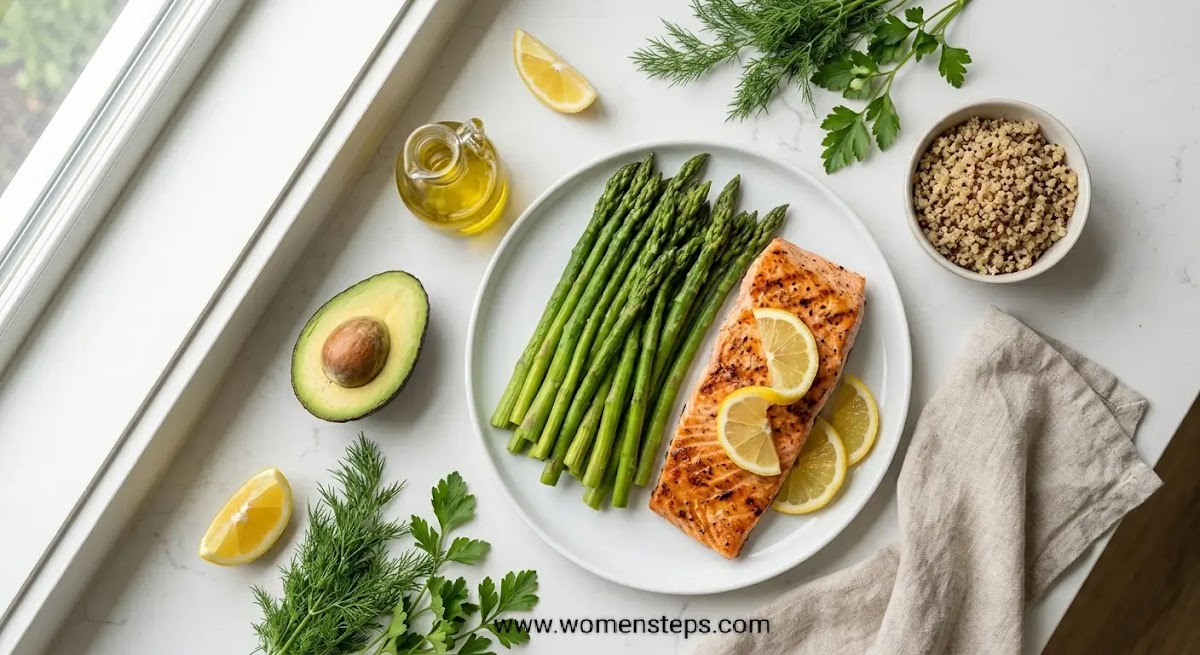
| Meal Component | Practical Examples | Potential Benefit |
|---|---|---|
| Protein | Fish, eggs, poultry, Greek yogurt, tofu, beans, lentils | Provides amino acids and supports muscle maintenance |
| Fiber-rich foods | Vegetables, fruit, beans, lentils, oats, whole grains | Supports digestive health and helps create satisfying meals |
| Healthy fats | Nuts, seeds, avocado, olive oil, fatty fish | Adds energy and nutrient density to a balanced eating pattern |
Research reviewed in PubMed suggests that adequate protein intake can be
important for maintaining muscle-related outcomes in older adults. However,
individual protein needs should be considered rather than treating one
number as a universal prescription.
PubMed — Dietary Protein Needs and Skeletal Muscle of Older Adults
For more information about dietary fiber and digestive health, see our
Ultimate Gut Health Guide for Women
.
4. Choose Carbohydrates for Quality, Not Fear
Carbohydrates do not need to be eliminated to lose weight. Whole grains,
legumes, vegetables, fruits, and other minimally processed carbohydrate
sources can provide fiber, vitamins, minerals, and energy.
A more sustainable strategy is to consider the overall quality of the food
and the portion that fits your individual energy needs.
- Choose whole or minimally processed carbohydrate sources frequently.
- Include vegetables and fruit as regular parts of meals.
- Pair carbohydrate foods with protein and other nutrient-dense foods.
-
Limit foods and drinks that provide large amounts of added sugar with
little nutritional value.
NIDDK recommends emphasizing nutrient-dense foods such as vegetables, whole
fruits, whole grains, lean protein sources, beans, peas, lentils, nuts,
seeds, and other nutritious foods as part of a healthy eating pattern.
NIDDK — Healthy Eating and Physical Activity
5. Increase Everyday Movement
Exercise is important, but your total daily movement also matters. Walking,
household activities, taking the stairs, gardening, standing periodically,
and other routine movements can help reduce sedentary time.
Current U.S. physical activity guidance recommends that adults aim for
150 to 300 minutes of moderate-intensity aerobic activity each week, or
75 to 150 minutes of vigorous activity, together with muscle-strengthening
activities on at least two days each week.
You do not have to complete all activity in one session. Physical activity
can be accumulated throughout the week and adjusted to your fitness level.
- Take a short walk after a meal when practical.
- Use stairs when appropriate and safe.
- Break up long periods of sitting.
- Walk while taking phone calls.
- Choose activities you enjoy so the routine is easier to maintain.
CDC — Physical Activity Guidelines for Adults
6. Treat Sleep and Recovery as Part of the Plan
Weight management is not only about food and exercise. Sleep, stress,
schedule, work demands, family responsibilities, and recovery can all
influence how easy it is to maintain healthy routines.
During the menopausal transition, sleep may also be affected by symptoms
such as hot flashes and night sweats. Persistent sleep problems should be
discussed with a healthcare professional when they interfere with daily
life.
Helpful habits may include maintaining a consistent sleep schedule, creating
a comfortable sleep environment, limiting stimulating activities close to
bedtime, and getting regular daytime physical activity.
Office on Women’s Health — Menopause Symptoms and Relief
Related WomenSteps Guide
You can also explore our
stress-relief routine for busy professional women
for practical ideas that can complement a sustainable lifestyle.
7. What About Intermittent Fasting After 40?
Intermittent fasting is one possible way of organizing meals, but it is not
a requirement for sustainable weight loss.
Some people find that a consistent eating schedule helps reduce unplanned
snacking or makes meal planning easier. Others may find fasting uncomfortable
or difficult to maintain.
There is no need to use increasingly long fasting periods simply because a
shorter eating schedule is not producing the expected result.
Women who are pregnant or breastfeeding, people with certain medical
conditions, people taking medications that affect blood glucose, and anyone
with a history of disordered eating should seek individualized medical advice
before intentionally restricting eating windows.
8. A Practical Weekly Strategy
A sustainable plan does not need to be complicated. The following framework
can be adapted to your current fitness level, schedule, preferences, and
healthcare needs.
| Focus | Practical Goal |
|---|---|
| Nutrition |
Build meals around protein, vegetables, fruit, whole grains or legumes, and appropriate portions. |
| Strength |
Perform muscle-strengthening activity at least two days per week when appropriate. |
| Aerobic activity |
Gradually work toward 150 to 300 minutes of moderate activity each week, or an equivalent amount of vigorous activity, when appropriate. |
| Daily movement |
Reduce prolonged sitting and add walking or other enjoyable movement throughout the day. |
| Sleep |
Maintain a consistent sleep routine and address persistent sleep problems. |
| Progress |
Evaluate progress over weeks and months rather than reacting to individual daily scale fluctuations. |
When to Speak With a Healthcare Professional
Weight changes can sometimes be related to medications, medical conditions,
menopause-related symptoms, sleep problems, or other factors that require
individualized assessment.
Consider speaking with a healthcare professional if you experience
unexplained or rapid weight change, persistent fatigue, significant
menopausal symptoms, dizziness, symptoms of an eating disorder, or difficulty
managing your weight despite consistent lifestyle changes.
A doctor, registered dietitian, or other appropriately qualified professional
can help determine whether additional evaluation, nutrition counseling,
medication, or other treatment is appropriate.
Frequently Asked Questions
Is resistance training important for women over 40?
Yes. Resistance exercise can help maintain or improve muscle strength and
physical function. The CDC recommends muscle-strengthening activity on at
least two days each week for adults, with the specific exercises and
intensity adjusted to individual ability and health status.
Why can weight loss become more difficult during midlife?
Multiple factors can contribute, including changes in activity, muscle mass,
energy needs, sleep, eating patterns, aging, and the menopausal transition.
These factors vary substantially between individuals.
Do women over 40 need to eliminate carbohydrates?
No. Eliminating carbohydrates is not necessary for everyone. Whole grains,
legumes, fruits, and vegetables can be part of a balanced eating pattern.
Overall food quality, portion size, energy intake, and individual health
needs are more useful considerations than eliminating an entire nutrient
category.
Is intermittent fasting necessary for weight loss?
No. Intermittent fasting is one possible eating pattern, not a requirement.
A sustainable eating schedule that provides adequate nutrition and fits your
lifestyle may be more important for long-term adherence.
What is the best exercise for sustainable weight management after 40?
There is no single best exercise for everyone. A balanced routine can include
muscle-strengthening activity, aerobic exercise, walking, mobility work, and
other enjoyable movement. The most useful routine is one that is appropriate
for your health and can be maintained consistently.
The Bottom Line
Sustainable weight management after 40 does not require extreme dieting.
A more practical approach combines appropriate nutrition, adequate
protein, muscle-strengthening exercise, regular movement, sleep, recovery,
and realistic habits that can continue over time.
Menopause and aging can change the experience of weight management, but
they do not make healthy habits irrelevant. Focus on progress, strength,
health, and consistency rather than chasing rapid changes on the scale.
Editorial & Evidence Policy
WomenSteps aims to provide practical, accessible health and wellness
information supported by reputable public-health resources and available
scientific literature. Health information is reviewed for clarity and
source quality, but WomenSteps does not replace individualized medical
care. Recommendations may not apply to every person or medical situation.
Evidence & Trusted Health Sources
The following resources provide additional information from government
health agencies and peer-reviewed medical literature.
-
U.S. Office on Women’s Health — Menopause and Your Health
-
U.S. Office on Women’s Health — Weight Loss and Women
-
U.S. Office on Women’s Health — Menopause Symptoms and Relief
-
CDC — Physical Activity Guidelines for Adults
-
National Institute on Aging — What Is Menopause?
-
National Institute on Aging — Maintaining a Healthy Weight
-
NIDDK — Eating & Physical Activity to Lose or Maintain Weight
-
NIDDK — Health Tips for Older Adults
-
PubMed — Dietary Protein Needs and Skeletal Muscle of Older Adults
Important:
Individual weight-management needs can vary considerably. If you have a
chronic condition, take prescription medication, are pregnant or
breastfeeding, have a history of disordered eating, or are planning a
substantial change to your diet or exercise routine, seek individualized
guidance from a qualified healthcare professional.