This article is provided for general educational purposes and does not provide
individualized medical advice, diagnosis, or treatment. Health decisions should
be discussed with a qualified healthcare professional who understands your
personal circumstances.
Women’s Health & Longevity
The Longevity Gap: Why U.S. Women Live Longer—and Why It’s Shrinking
Women still have a meaningful life-expectancy advantage in the United States.
The latest national data, however, show that the difference between women
and men is becoming smaller. Here’s what the numbers tell us—and what they
do not tell us.
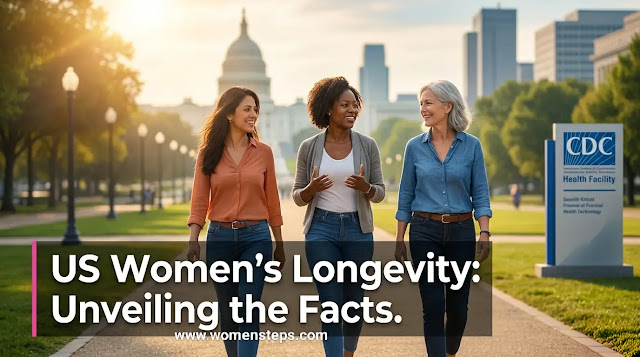
healthcare, social conditions and broader public-health factors.
How long people live is influenced by much more than biology. Access to
healthcare, income, education, working conditions, behavior, chronic disease,
injury risk and the environment around us can all influence population health.
One of the clearest patterns in U.S. mortality statistics is that women have
historically lived longer than men.
But that advantage is not fixed. According to final 2024 data from the
CDC’s National Center for Health Statistics (NCHS), life expectancy
at birth was 81.4 years for U.S. females and
76.5 years for U.S. males. That represents a difference of
4.9 years. In 2023, the difference was 5.3 years, meaning the gap narrowed
by 0.4 year in 2024.
That change raises an important question: if women still live longer on
average, why is the longevity gap getting smaller? The answer is complicated.
It involves changes in mortality among men, chronic diseases affecting both
sexes, behavioral patterns, healthcare, socioeconomic conditions and
biological differences.
Key Takeaways
- U.S. women had a life expectancy of 81.4 years in 2024.
- U.S. men had a life expectancy of 76.5 years in 2024.
-
The female–male life-expectancy gap was 4.9 years in 2024,
down from 5.3 years in 2023. -
Women’s longer average lifespan cannot be explained by one biological
factor. Biology, behavior, healthcare and social conditions all matter. -
Living longer does not automatically mean spending more years in good
health. Healthspan and quality of life are also important.
What the Latest U.S. Numbers Tell Us
The most recent final mortality data from the CDC show that life expectancy
increased for both women and men between 2023 and 2024. However, the increase
was larger for men, which is why the female–male gap became smaller.
Years: female life expectancy at birth, 2024
Years: male life expectancy at birth, 2024
Years: female–male life-expectancy gap, 2024
Female vs. Male Life Expectancy
| Measure | 2023 | 2024 | Change |
|---|---|---|---|
| Female life expectancy at birth | 81.1 years | 81.4 years | +0.3 year |
| Male life expectancy at birth | 75.8 years | 76.5 years | +0.7 year |
| Female–male gap | 5.3 years | 4.9 years | −0.4 year |
Source: U.S. Centers for Disease Control and Prevention, National Center
for Health Statistics, Mortality in the United States, 2024.
Why Have Women Historically Lived Longer?
The female longevity advantage is not the result of one simple cause.
Researchers have examined biological, behavioral and social explanations,
and the evidence points to an interaction between many factors.
Biological differences may play a role
Sex-related biological differences may influence cardiovascular health,
immune responses, metabolism and other processes associated with aging.
Hormones, chromosomes and differences in biological aging have all been
studied as possible contributors to the longevity difference.
However, it would be misleading to describe one biological mechanism as
the definitive reason women live longer. Human longevity is influenced by
multiple interacting factors, and population differences cannot be reduced
to biology alone.
Behavior and risk exposure also matter
Differences in health-related behaviors and exposure to certain risks can
influence mortality. Smoking, alcohol use, occupational hazards, road
injuries, violence, substance use and other external causes of death have
not affected women and men in exactly the same way.
These patterns can be especially important because deaths occurring earlier
in adulthood have a larger effect on life expectancy than deaths occurring
at very advanced ages.
Healthcare and prevention contribute too
Women and men may differ in when and how they interact with healthcare
services. Preventive care, screening, treatment of chronic conditions and
timely management of health problems can all influence outcomes.
Healthcare utilization is only one part of the picture, however. The ability
to obtain care, afford medication, take time away from work, access healthy
food and live in a safe environment can also shape health outcomes.
Why Is the Longevity Gap Shrinking?
The latest numbers provide an important clue. Between 2023 and 2024,
female life expectancy increased by 0.3 year, while male life expectancy
increased by 0.7 year. As a result, the difference between the two groups
decreased from 5.3 years to 4.9 years.
A narrowing gap does not mean that women are suddenly
losing their longevity advantage. Women continued to have the higher
life expectancy in 2024. Instead, the change means that mortality improved
more for men than for women during that particular period.
A shrinking gap can happen because one group gains more years, because
mortality patterns change differently between groups, or because both
happen at the same time. A single year’s movement should therefore be
interpreted in the context of longer-term trends rather than treated as
proof of a permanent reversal.
Several forces can influence the difference
-
Changes in premature mortality:
Deaths occurring among younger and middle-aged adults can have a
disproportionate effect on life expectancy. -
Chronic disease:
Cardiovascular disease, cancer, diabetes and other chronic conditions
influence mortality patterns for both sexes. -
External causes:
Injuries, overdoses and other external causes of death can affect
male mortality particularly strongly in some age groups. -
Changes in healthcare and prevention:
Improvements in diagnosis, treatment and prevention can affect
mortality differently across populations. -
Social and economic conditions:
Employment, income, education, housing, environment and access to
healthcare all contribute to population health.
The broader lesson is that the longevity gap is not a fixed biological
constant. It can change as health risks, medical care, behavior and social
conditions change.
What Happens After Age 65?
Life expectancy at birth is only one way to look at longevity. Another
useful measure is the number of additional years people are expected to
live after reaching age 65.
In 2024, the CDC estimated remaining life expectancy at age 65 at
20.8 years for females and 18.4 years for males.
The female–male difference at age 65 was therefore 2.4 years.
This is different from the 4.9-year gap at birth. It illustrates why
longevity statistics should always be interpreted in context: the size
of the difference depends on the age at which life expectancy is measured.
Life Expectancy Is Not the Same for Every U.S. Population
National averages can hide substantial differences between populations.
Life expectancy varies by race and Hispanic origin, geography,
socioeconomic circumstances and other factors.
These differences should not be interpreted as biological rankings.
Population health is shaped by a complex combination of income, education,
healthcare access, neighborhood conditions, occupational exposures,
environmental factors, chronic disease, discrimination and many other
influences.
For that reason, this article does not present a simple ranking of racial
or ethnic groups as though one number could explain the health experience
of every woman. The CDC’s mortality and life-table datasets provide the
appropriate context for examining differences between populations.
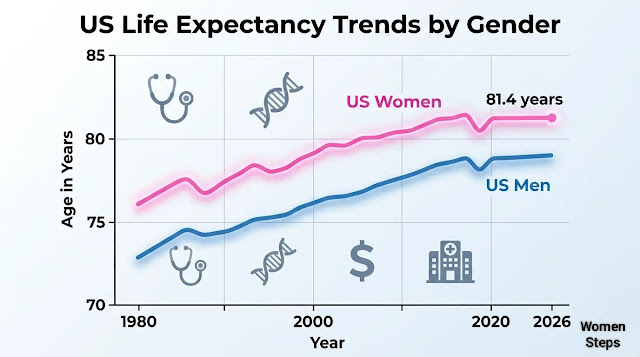
individual’s lifespan.
Heart Disease Remains a Major Concern for Women
Living longer does not mean women are protected from serious chronic
disease. Heart disease remains the leading cause of death among
women in the United States.
According to the CDC, heart disease was responsible for
304,970 deaths among U.S. women in 2023, representing
about one in five female deaths that year.
Important cardiovascular risk factors include high blood pressure,
high cholesterol, diabetes, smoking, physical inactivity and other
individual and environmental factors. Women can also experience heart
disease differently at different stages of life.
The practical lesson is not that every woman needs the same medical
screening schedule. Rather, cardiovascular risk should be discussed
with a healthcare professional based on age, family history, symptoms,
existing conditions and other individual factors.
The Biological Side of Female Longevity
Biology is one part of the longevity story. Researchers have investigated
the possible roles of sex hormones, sex chromosomes, immune function,
cellular aging and other biological differences.
Estrogen, for example, has important effects on several body systems,
including the cardiovascular system. However, it would be inaccurate to
turn this into a simple claim that estrogen alone explains women’s longer
lives. Hormonal changes across the life course are complex, and individual
health outcomes vary considerably.
The strongest explanation is therefore a combination of biology and
lived experience rather than a single “female longevity gene” or
one protective hormone.
Living Longer Does Not Always Mean Living Healthier
One of the most important distinctions in conversations about longevity
is the difference between lifespan and
healthspan.
Lifespan refers to how long a person lives. Healthspan refers more broadly
to the years spent in relatively good health and with the ability to
participate in everyday life.
A longer average lifespan is valuable, but the quality of those additional
years matters too. Chronic disease, mobility limitations, cognitive
problems and loss of independence can affect later life even when a
person reaches an advanced age.
“What can I do to improve the chances of remaining healthy, independent
and active as I age?”
Practical Ways to Support Healthy Aging
No lifestyle strategy can guarantee a particular lifespan. However,
several broadly established health behaviors can support cardiovascular,
metabolic, muscular and overall wellbeing.
-
Know your cardiovascular risk factors.
Keep track of health measures that your healthcare professional
recommends, such as blood pressure, cholesterol and blood glucose.
Ask what your personal risk factors mean rather than relying on
population averages. -
Stay physically active.
Regular movement supports cardiovascular fitness, muscle function,
mobility and overall health. Include activities appropriate for your
age, abilities and health status. -
Protect muscle and bone strength.
Resistance and weight-bearing activities can be useful components of
healthy aging. If you have an injury, chronic condition or other
limitation, ask a qualified professional how to exercise safely. -
Build a balanced eating pattern.
A varied diet that includes vegetables, fruits, whole grains, legumes,
nuts, adequate protein and other nutrient-rich foods can support
overall health. Individual dietary needs vary. -
Protect sleep and social wellbeing.
Consistent sleep, meaningful relationships and opportunities for
social connection are important parts of overall wellbeing. Persistent
sleep or mental-health concerns deserve professional attention.
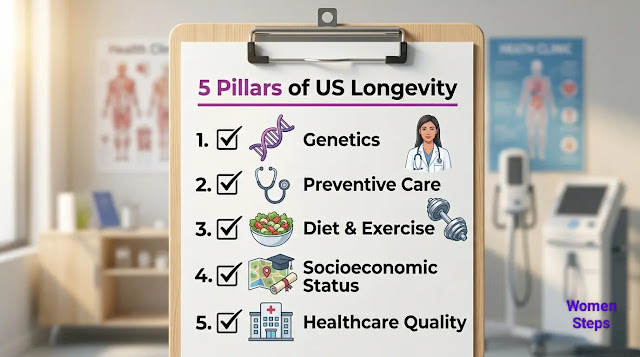
physical activity, nutrition and social wellbeing.
Why Social and Economic Conditions Matter
Longevity is not determined entirely by individual choices. Where a person
lives, works and ages can affect the opportunities available to maintain
good health.
Access to healthcare, affordable medicines, nutritious food, safe housing,
transportation, education, stable employment and clean environments can
all influence health outcomes.
This is why telling people simply to “make healthier choices” can be
incomplete. Personal behavior matters, but health is also shaped by the
circumstances in which people make those choices.
What the Longevity Gap Means for Women
The latest statistics provide both good news and an important reminder.
Women continue to have a longer average life expectancy than men in the
United States. At the same time, the advantage is not permanent or
guaranteed.
The narrowing gap also demonstrates why longevity should not be treated
as a competition between women and men. Changes in mortality can affect
both groups, and the reasons behind those changes are often connected to
broader public-health conditions.
For individual women, the most useful takeaway is to focus less on a
single life-expectancy number and more on the factors that can support
health and independence throughout the years: preventive care, physical
activity, nutritious eating, adequate sleep, social connection and
appropriate management of health risks.
Frequently Asked Questions
According to final 2024 CDC data, life expectancy at birth for U.S.
females was 81.4 years.
In 2024, female life expectancy at birth was 81.4 years compared with
76.5 years for males. The difference was therefore 4.9 years.
Yes. The CDC reported a female–male life-expectancy difference of
5.3 years in 2023 and 4.9 years in 2024. The gap therefore narrowed
by 0.4 year in 2024.
Researchers consider several explanations, including biological
differences, health behaviors, injury and risk exposure, healthcare
patterns and social conditions. No single factor completely explains
the female longevity advantage.
Heart disease remains the leading cause of death for women in the
United States. CDC data show that heart disease caused about one in
five female deaths in 2023.
Not necessarily. Life expectancy measures expected length of life,
while healthspan focuses on the years lived in relatively good health.
A longer lifespan and a healthier lifespan are related but not identical.
Sources & Further Reading
This article uses publicly available information from established
U.S. health and scientific sources. Readers can review the underlying
information directly:
-
CDC National Center for Health Statistics — Mortality in the United States, 2024
-
CDC National Center for Health Statistics — Life Expectancy
-
CDC — About Women and Heart Disease
-
CDC National Center for Health Statistics
-
National Institutes of Health
Statistics and health information can be updated as new national data
become available. Readers should consult the original source for the
latest figures.

Richa M.
Medical disclaimer:
The information provided in this article is for general educational
purposes only. It is not intended to diagnose, treat, cure or prevent
any disease or to provide individualized medical advice. Always consult
a qualified healthcare professional regarding symptoms, medical
conditions, medications, screening decisions or treatment choices.
Leave a Reply